Standing Form

(Two-part) Sculpture
Stoneware, engobe, and glaze
With pedestal
53,5 x 19 x 19 cm
Without pedestal
34 x 14 x 11 cm
Unique work, 2026

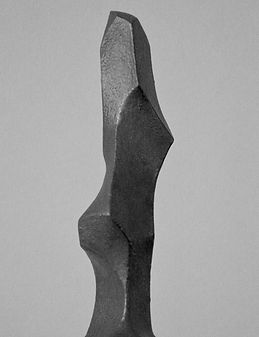
Standing Form unfolds as a vertical landscape: part growth, part gesture, part memory. Sculpted entirely by hand, the work moves between sharp protrusions and gentle curves, holding tension and delicacy in balance.
Its silhouette recalls a flowering body or a plant suspended mid-bloom, caught between emergence and erosion. As daylight moves across its bronze-like surface, shifting light reveals changing relationships between pointed edges and rounded volumes.

“The work begins with an imagined act of listening to a plant. Drawing on the bioelectric signals of wild white and pink roses, translated into sound through modular synthesis, it considers the plant as a body with its own rhythms, vibrations, and language. I imagine closing my eyes and attending to its smallest movements: wind passing through a petal, the subtle friction of contact, a shift in breath or atmosphere. Through this act of listening, the rose becomes both material presence and a point of entry into an otherworldly space—one in which distinctions between body, plant, sound, and surroundings begin to dissolve.”
Zeynep Boyan
References

i. Bio Music Vibrations: Listening to wild roses (2026).

iii. Hilma Af Klint, Convallaria majalis (Lily of the Valley), Geum rivale (Water Avens), Polygala vulgaris (Common Milkwort). Sheet 11 from the portfolio: Nature Studies, June 10–11, 1919.
_Hilma%20af%20Klint.webp)
ii. Hilma af Klint, Altar piece No.2 (1915).

iv. Karl Blossfeldt, Silphium laciniatum, compass plant (1900-28).

v. Karl Blossfeldt, Polystichum munitum, Wunder in der Natur, c. 1920s.

vi. Hilma Af Klint, Primordial Chaos No. 16.